
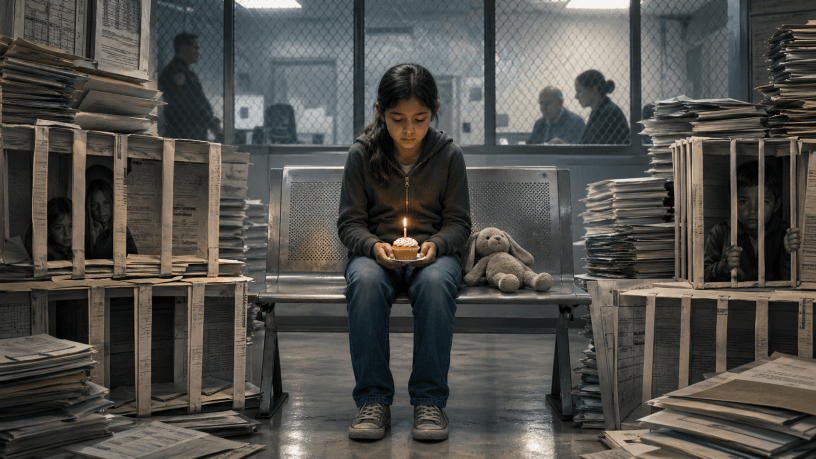
There is a special kind of national sickness required to put an 11-year-old girl in immigration detention on her birthday and then pretend the issue is “process.”
Not violence. Not cruelty. Not state terror dressed up in khakis and laminated badges. Process.
The girl’s name is Manpreet. According to The Guardian, she and her family fled India after her father converted from Sikhism to Catholicism and feared religious persecution. They had settled in Los Angeles. Then, during what was supposed to be a routine immigration check-in, the machinery did what machinery does: it swallowed them. The family ended up at the Dilley immigration detention center in Texas, where Manpreet spent her 11th birthday in custody. Her wish was not for a bike, a cake, a phone, a dog, or a normal American childhood. Her wish was that her family could go home.
That should be the whole scandal. That sentence alone should be enough to make every flag pin in Washington burst into flames.
An 11-year-old child spent her birthday in a detention center because her family obeyed the rules enough to show up.
But America has an extraordinary talent for sanding the blood off the edges of its worst behavior. We do not “kidnap.” We “detain.” We do not “jail children.” We “process family units.” We do not create trauma. We “enforce immigration law.” We do not build cages anymore, at least not linguistically. We build “family residential centers,” as if the family is on a weird Groupon vacation where the towels are scratchy and everyone has legal nightmares.
This is how a country keeps its conscience alive while doing dead things.
The Check-In Trap
The ugliest part of this system is not that it is chaotic. It is that it is orderly.
A family goes to an immigration appointment. They bring documents. They enter a government building. They try to comply with a legal process that already feels like being trapped inside a filing cabinet designed by Kafka and maintained by Comcast. Then the door closes behind them.
There is something especially rotten about punishing people at the very moment they are complying. It turns the check-in into bait. It teaches immigrants that the law is not a path, but a snare. Show up, get bagged. Cooperate, get transported. Believe in the process, and the process will introduce your children to institutional lighting.
This is not some wild aberration. Dilley has become a symbol of the return of family detention. PBS reported that since the facility reopened in March 2025, it had held around 3,500 people, more than half of them children, while families and advocates described contaminated food, illness, and grim conditions. The New Yorker recently described “the return of family detention” under the Trump administration, reporting that thousands of immigrant children have been detained and that many have suffered from medical neglect.
This is the American genius: take something obviously monstrous — imprisoning kids — and bury it under enough acronyms, contracts, hearings, notices, vans, wristbands, and intake forms that everyone can claim it is simply how the system works.
Well, yes. Exactly.
That is the indictment.
Family Values, With Barbed Wire
The official sales pitch is always that this is necessary. Order must be maintained. Borders must be secured. Laws must be enforced. The system must have consequences.
Fine. But then say plainly what the consequence is.
The consequence is a child spending her birthday in custody.
The consequence is a mother with diabetes and arthritis reportedly struggling with inadequate food and medical care. The consequence is children showing psychological distress. The consequence is disrupted education, uncertainty, fear, and the slow institutional crushing of people whose primary offense is wanting to live somewhere safer than where they came from.
The people who defend this will say: “Well, they should have come legally.”
This is the magic phrase that turns off the brain like a light switch. Many asylum seekers are, in fact, trying to use the legal system. That is often how they end up at the appointments where ICE can grab them. But “come legally” has never really meant “use the law.” It means “be the kind of person we would have approved of before you got here.” It is not a legal standard. It is a moral costume for exclusion.
And when that fails, the defenders retreat to the great American shrug: “They’re not citizens.”
As if citizenship is the line between human being and storage item.
This country has a funny way of worshiping children in the abstract while treating actual children as acceptable collateral damage. Every politician is “pro-family.” Every campaign ad has a golden retriever and a kid in a soccer jersey. Every school board crank is protecting “the children” from library books, pronouns, history, drag queens, TikTok, seed oils, and whatever new hallucination the grievance industry spit out this week.
But put a migrant child in detention and suddenly the same civilization that can detect Satan in a Target display becomes very sophisticated about jurisdiction.
The Cruelty Is the Message, But So Is the Boredom
The phrase “the cruelty is the point” became popular during Trump’s first term, and it still applies. But it is not enough anymore.
The boredom is also the point.
Cruelty gets attention. Boredom prevents accountability. A screaming child on camera can become a scandal. A child in a detention center on her birthday becomes a case file. A family’s terror becomes a docket entry. A mother’s illness becomes a medical request. A child’s fear becomes “behavioral health.” The horror gets translated into institutional mush until there is nothing left for the public to grab onto.
That is why the story of Manpreet matters. It cuts through the mush.
You do not need a law degree to understand an 11-year-old birthday. You do not need to parse asylum rules to know a child should not be wishing to go home from inside an immigration detention center. You do not need to be an immigration expert to recognize that a government powerful enough to track, seize, transport, confine, and litigate against a family is also powerful enough to choose not to do that.
And Dilley is not an isolated morality accident. In another recent case, a mother and five children from Egypt were released after more than 10 months in ICE custody, then reportedly re-detained days later before judges intervened. The Texas Tribune reported that a flight carrying the family turned around after a judge ruled they should remain in the U.S.; The Guardian reported that the case had drawn attention because of the family’s prolonged detention and allegations of poor medical care and unsanitary conditions at Dilley.
Ten months.
That is not a “temporary hold.” That is a school year. That is a lost season of childhood. That is enough time for a child to learn a new fear as a native language.
The Machine Always Finds a Child-Sized Door
The moral trick of immigration politics is to talk about “the border” as if it is an abstraction. A line. A concept. A national membrane. Something clean and geometric.
But enforcement never stays abstract. It becomes a van outside an apartment. A checkpoint. A locked door. A courtroom where nobody understands the language. A kid losing weight. A mother trying to manage diabetes on detention-center food. A birthday in custody.
The border comes for the child eventually. The machine always finds a child-sized door.
And when it does, America starts making excuses. The excuses are old and filthy from overuse. They broke the law. Their parents made choices. We cannot take everyone. What about our own children? What about crime? What about the taxpayer? What about the sacred rule of law, which apparently requires the full weight of the federal government to be dropped onto an 11-year-old girl but develops sudden osteoporosis when billionaires need prosecuted?
This is the same country that can spend decades failing to secure universal health care, affordable housing, decent schools, safe drinking water, and functioning mental health services, then suddenly becomes a Nordic efficiency machine when the task is imprisoning immigrant families.
Need a dentist? Good luck.
Need insulin? Start a GoFundMe.
Need a working public defender? Take a number and pray.
Need a child detained in Texas after an immigration appointment? Somehow the logistics come together.
The Administrative State of Shame
There is a broader story here about how America launders brutality through administrative normalcy.
The ugliest systems rarely announce themselves with cartoon villain music. They come with forms. They come with agencies. They come with euphemisms. They come with spokespersons who say things like “all detainees receive appropriate care” while advocates, families, doctors, journalists, and basic human observation scream otherwise.
That is why child detention is such a perfect American scandal. It combines all the country’s worst addictions: punishment as policy, bureaucracy as moral anesthesia, privatized misery, racial panic, legal complexity, and the endless belief that suffering becomes acceptable once a contractor invoices it correctly.
The child does not disappear into a dungeon. She disappears into procedure.
And procedure is where outrage goes to die.
Nobody is responsible because everyone is just doing their job. The agents are enforcing the law. The facility is following standards. The lawyers are filing motions. The politicians are demanding order. The public is told this is complicated. The television panel moves on. The kid remains in custody.
This is how evil survives in a country that still wants to think of itself as decent. Not by convincing everyone to love cruelty. By making cruelty boring enough to ignore.
Happy Birthday from the Homeland
There is no policy justification that survives contact with the image of a detained child’s birthday.
None.
You can support stricter immigration laws and still recognize that jailing children is a moral obscenity. You can believe in borders and still understand that a government with aircraft carriers, biometric databases, surveillance systems, armed agents, private detention contracts, and the largest economy on Earth does not need to prove its strength by terrifying families at check-ins.
But terror is useful. That is the dark little engine inside all of this. The point is not only to detain the family in front of you. The point is to send a message to every other family watching: do not get comfortable. Do not trust the appointment. Do not believe the paperwork. Do not think your child’s birthday matters here.
The message is received.
America is once again explaining its greatness through the medium of children crying in government custody.
And the worst part is not that the system failed.
The worst part is that it appears to be working exactly as designed.
 The American Beast