
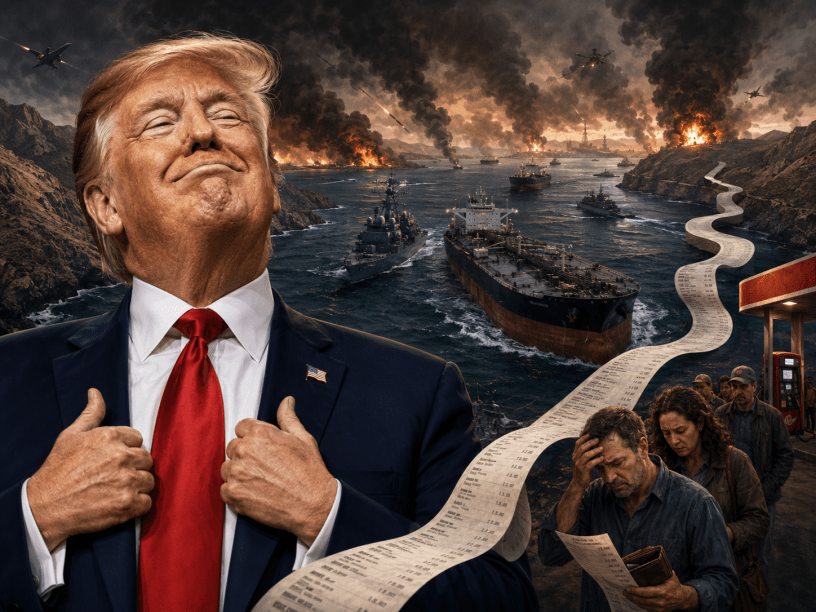
There is no American political ritual more sacred than declaring victory over a disaster we helped create.
After weeks of oil panic, naval chest-thumping, economic whiplash, and the usual televised blood gargling from the professional Serious People, the Trump administration appears to be inching toward a deal with Iran. Not a grand peace. Not a historic settlement. Not one of those leather-bound diplomatic orgasms where everyone pretends the world has been saved by men in dark suits.
No, the great imperial off-ramp may be a one-page memorandum: fourteen points, thirty more days of talks, a pause in the Gulf war, and a vague promise to stop squeezing the global economy by the throat.
In other words, after the threats, explosions, shipping panic, gas-price spikes, and “Project Freedom” branding, the whole thing may come down to a glorified napkin.
Naturally, this will be sold as brilliant statesmanship.
Trump has reportedly paused Project Freedom, the U.S. operation meant to escort ships through the Strait of Hormuz, while negotiations continue. He has also warned that if Iran does not accept the proposal, military action could resume at a “much higher level.”
This is the foreign-policy equivalent of setting your neighbor’s garage on fire, turning off the hose halfway through, and demanding a Nobel Prize because you are “exploring water-based solutions.”
Project Freedom, Because Project Maybe Don’t Start a War Was Too Long
You have to admire the branding discipline. Project Freedom. Epic Fury. These people cannot move a destroyer, invade a lunchroom, or lose a stapler without naming the operation like a rejected Mountain Dew flavor.
Project Freedom was supposed to show the world that America still controls the sea lanes. Instead, it demonstrated that global shipping, oil prices, and American political stability can be held hostage by the exact kind of crisis Washington insists only Washington is qualified to manage.
The Strait of Hormuz is not some obscure puddle near a Tom Clancy fever dream. It is one of the most important energy chokepoints on Earth. Threaten it, block it, militarize it, or even make markets think it may stay unstable, and ordinary people thousands of miles away start paying for empire every time they fill a gas tank.
That is the whole rotten system in miniature. Working people get hammered by the crisis. Markets get euphoric at the rumor that the crisis may stop. The people who helped create the crisis go on television to explain how courageous they are.
The Dow does not care how many sailors sweated through those waters. Brent crude does not care whether the guy in Albany, Toledo, or Fresno just paid ten extra bucks to get to work. The market is not a moral instrument. It is a dog licking grease off a crime scene.
The Arsonist Discovers Fire Safety
The official story will be simple: Trump stood strong. Iran blinked. America restored order. Peace through strength. Cue the eagles.
But the actual shape of the thing looks uglier. Iran blocked the Strait. The U.S. escalated. Israel was involved in the broader war. Shipping froze. Fuel prices rose. America threatened force. Other countries helped talk everyone down. And now the White House may accept a limited framework that postpones or leaves out some of the same issues hawks claimed were non-negotiable five minutes ago.
This is not chess. It is a toddler with a handgun being gently talked down by other adults in the room.
The American empire has a remarkable gift for manufacturing emergencies that later require American leadership. We create the conditions for chaos, then demand applause for participating in the cleanup.
Iraq was going to be liberated. Afghanistan was going to be remade. Libya was going to be saved. Syria was going to be managed. Iran was going to be contained. Every few years the same dead-eyed salesmen emerge from the same think tanks to tell us that this time the stove is definitely not hot.
Then the public gets burned and the salesmen get promoted.
The Gas Pump Is the Real War Memorial
For most Americans, foreign policy is not an abstract question of regional balance, maritime security, deterrence architecture, or whatever phrase a cable-news colonel uses when he wants to sound like a haunted Pentagon brochure.
Foreign policy is the price of gas. It is groceries. It is whether your paycheck evaporates before rent. It is your kid asking why you are angry at the pump while some senator explains that sacrifice is necessary for freedom, which always seems to mean your sacrifice and his freedom.
That is why the Hormuz crisis matters domestically. It turns the machinery of empire into a receipt. You do not need to understand naval logistics to understand getting mugged by a gas station.
And the most insulting part is the tone. Americans are expected to be grateful when the people in charge merely stop making things worse. Gas jumps because the world’s chokepoint is on fire, then oil falls when diplomats maybe find a piece of paper, and suddenly we are supposed to marvel at the genius of the man holding the match.
This is how the racket works. First, the ruling class creates volatility. Then it monetizes volatility. Then it calls de-escalation “leadership.” Then it tells you to vote harder, support the troops, and stop asking why your life keeps getting more expensive every time a president needs to look tough.
Peace, But Make It Threatening
Even the peace talk comes wrapped in menace. The message is not exactly Gandhi in a cardigan. It is: sign the paper, or we go back to breaking things.
Maybe that works. Maybe Iran signs. Maybe Hormuz reopens. Maybe oil stabilizes. Maybe the whole mess gets memory-holed by Friday’s cable-news buffet.
But even if the memorandum holds, the public should refuse to forget the sequence.
They told us escalation was necessary. Then they told us restraint was genius. They told us military pressure was the only language Iran understood. Then they celebrated diplomacy. They told us maximal demands were essential. Then they entertained a partial memo that kicks major questions into another month of talks.
This is not strategy. It is a hostage video filmed by a superpower.
If the deal falls apart, the hawks will say diplomacy failed because America was too soft. If the deal succeeds, the same people will say military pressure worked because America was tough. If gas prices remain high, it will be Iran’s fault. If prices drop, it will be Trump’s triumph. If ships move, Project Freedom worked. If Project Freedom stays paused, the pause was strategic.
There is no outcome where the architects of the mess admit the obvious: they gambled with the global economy, used ordinary people as shock absorbers, and then tried to turn a partial retreat into a parade.
The Receipt
Maybe the war winds down. Maybe the memorandum becomes something real. Maybe by next week everyone involved will be standing in front of flags, congratulating themselves for avoiding the catastrophe they spent months flirting with.
Fine. Take the peace. Take any off-ramp that keeps sailors alive, oil moving, and civilians out of the blast radius.
But do not let them sell it as genius.
This was not the fire department saving the town. This was the arsonist noticing the wind had shifted toward his own house.
And now, as usual, the bill will be passed downward. To the commuter at the pump. To the worker watching prices jump. To the soldier told to stand ready. To the public asked to confuse panic management with leadership.
The war may end.
The scam does not.

