
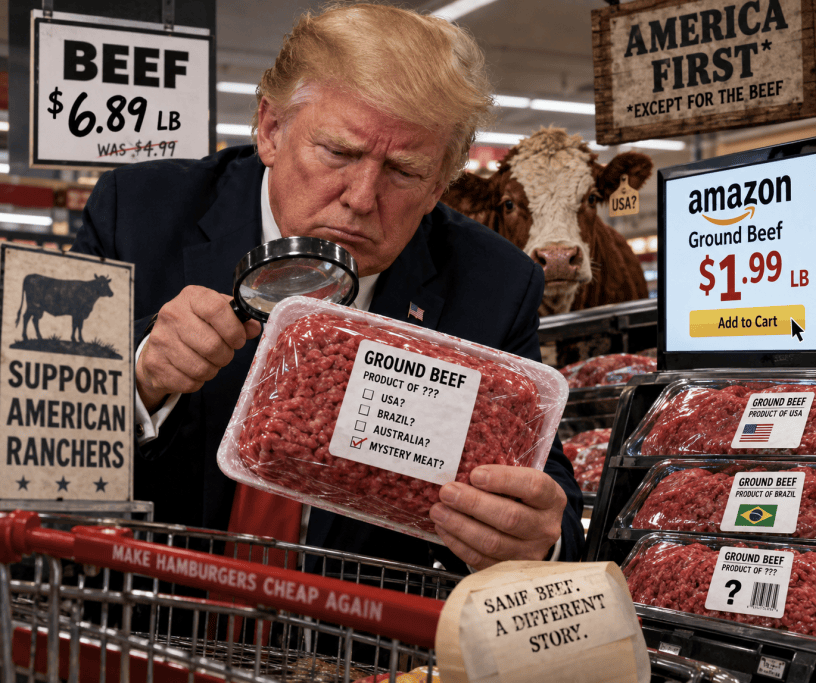
Donald Trump wanted to make hamburger cheap. Instead, he has created a strange new question in American grocery aisles: Where, exactly, did this meat come from?
There was a time, not very long ago, when Donald Trump would have considered the idea of importing hundreds of thousands of tons of foreign beef into the United States an act of economic treason. The whole point of Trumpism was supposed to be that America had been getting screwed by foreigners for decades, and the solution was to put tariffs on their shit until they either came crawling back to Washington with a check or stopped making shit altogether.
Tariffs were going to rebuild American manufacturing, protect American farmers and workers, and, according to Trump, make other countries pay for the privilege of selling things to Americans.
Then Americans started looking at the price of hamburger. The national average for ground beef reached roughly $6.89 a pound in July, an extraordinary number for a product that used to occupy the cheap end of the meat counter. Beef and veal prices were up 9.4 percent from a year earlier, with roasts up more than 13 percent. The problem wasn’t theoretical anymore. It was sitting in a Styrofoam tray under fluorescent lights, and people were beginning to think that maybe tacos could be made with something other than cow.
So Trump did something that would have been almost unthinkable during the first act of his tariff revolution: he decided America needed more foreign beef. On August 21, Trump announced that the United States would allow an additional 300,000 metric tons of lean beef trimmings into the country over the following 90 days at the lower in-quota tariff rate. The administration’s stated purpose was straightforward: increase the supply of beef available for grinding and bring down prices while American ranchers rebuild the domestic herd. Trump said the imported beef would be sold at 25 percent below current market prices.
The first 100,000-ton tranche opened September 1, with additional tranches scheduled through November 30. It is an eminently understandable response to an actual problem. It is also a spectacularly awkward one for the president who spent years telling Americans that the way to save American producers was to make foreign competition more expensive. The cattle herd is at a 75-year low. Drought, high costs and years of herd liquidation have left the United States with fewer animals than the market needs. The administration can bring in foreign beef tomorrow; it cannot manufacture a new American cow tomorrow. Rebuilding the herd will take years, which means the White House is trying to solve a long-term supply problem with a short-term supply injection. And now the people who raise cattle are watching the price of cattle fall.
The Beef Problem Is Real
There is no reason to pretend the beef crisis is something Trump invented. The American cattle industry has been squeezed by a genuine shortage. The supply of cattle available to processors is unusually tight, and that has pushed cattle prices to extraordinary levels. Tyson Foods, one of the country’s largest meat processors, cut its profit forecast again this week as its beef business continued to suffer from high cattle costs and weak consumer demand. The company has already revised its outlook downward once this year. This is not an industry suffering because somebody forgot to put enough tariffs on Argentina. It is an industry that doesn’t have enough cattle.
And the reason this matters is that there is no quick political solution to a biological problem. A rancher deciding to rebuild a herd isn’t like a manufacturer deciding to add another production line. Cows have to be bred, calves have to be born, calves have to grow, feed costs have to be paid along the way, and a rancher has to believe that the economics will still make sense years from now. The administration knows this. That is why the White House describes the import program as temporary and insists that the ultimate goal is to help American ranchers rebuild the herd. But the cattle market doesn’t care about the rhetorical distinction between “temporary foreign competition” and “long-term support for American ranchers.” When the government announces that 300,000 metric tons of additional lean beef are coming into the country, buyers immediately have to reconsider what domestic cattle are worth. That happened almost instantly. Cattle prices dropped after Trump’s announcement, alarming ranchers who had already spent years trying to recover from the supply crunch. Farm groups warned that bringing in large quantities of cheaper foreign beef could undermine the economics of rebuilding the very herd the administration says it wants to rebuild. Republican senators from cattle-producing states have joined the criticism.
In other words, Trump is trying to make beef cheaper for the person buying the hamburger while keeping beef expensive enough for the person raising the cow. That is not impossible. It is just a hell of a trick.
The Great Trump Beef Discount
Then there is the 25 percent. Trump didn’t merely say the additional imports would increase supply and put downward pressure on prices. He announced that he had a commitment that the beef would be sold at 25 percent below current market prices. The White House subsequently ordered the government to monitor the results and says Trump can terminate the arrangement if the imported product isn’t producing lower prices. It is the sort of promise that sounds fantastic in a social-media post because the number is so clean. Twenty-five percent. Not “some savings.” Not “a modest reduction.” A quarter off.
The problem is that commodity markets are not department-store clearance racks. The price of a pound of hamburger reflects the cattle, the processor, transportation, labor, packaging, retail margins and a dozen other variables between a ranch in Kansas and the meat case at a supermarket in New Jersey. And the imported product isn’t even necessarily the hamburger sitting in that meat case. The administration’s quota is for lean beef trimmings—the lean portions used in making ground beef. Those trimmings can be combined with other beef, including domestic beef, to produce the ground beef Americans actually buy. The entire additional quota amounts to roughly 2 percent of annual U.S. beef consumption, according to agricultural analysts. So the Trump administration is essentially betting that a relatively modest increase in one component of the ground-beef supply will produce a meaningful reduction in retail prices. Maybe it will. But the people who actually study the beef market aren’t expecting a miracle, and the ranchers certainly aren’t praying for one.
Suddenly Everyone Wants to Know Where the Meat Came From
The most interesting consequence of all this may have less to do with cattle prices than with something considerably more basic: Americans have started asking where their meat comes from. That’s not entirely irrational. The USDA’s new “Product of USA” standard, which took effect January 1, requires beef carrying that claim to come from animals born, raised, harvested and processed in the United States. The department has spent much of this year encouraging producers to use the label as a way for consumers to identify genuinely American meat.
But the important word is voluntary. The absence of “Product of USA” doesn’t mean that a package is foreign, and USDA quality grades such as Prime and Choice tell consumers about quality, not the animal’s nationality. Ground beef complicates things further. Federal country-of-origin rules allow raw materials from different countries to be commingled in ground meat, with the relevant countries identified on the label. The rules governing ground meat are not the same as those governing an individual steak or roast, where the production history of the animal is much more directly tied to the labeling requirements.
None of this means that American supermarkets are secretly selling dangerous meat. It means that the modern hamburger has a surprisingly complicated passport. A package of ground beef can contain meat from more than one source. The meat may be processed in the United States without the cattle having been born and raised here. A “USDA” designation can refer to inspection or quality rather than origin. And unless the package carries a voluntary American-origin claim, the consumer may have to read considerably more carefully than the giant American flag on the packaging would suggest.
This is not a new phenomenon. What is new is the level of attention. Because once the president tells you he is going to solve the beef shortage by importing a mountain of foreign lean beef, you start looking at the package differently. You start wondering what exactly “Product of USA” means, whether the hamburger was made from domestic cattle, whether it was blended with imported beef, and why the package sitting next to it costs twice as much.
Then Amazon starts selling ground beef for $1.99 a pound.
The $1.99 Hamburger
The Amazon promotion is where this story takes a turn from agricultural policy into something that feels almost surreal. In late August, Amazon Grocery offered one-pound packages of 80/20 ground beef for $1.99, dramatically below the national average of about $6.89. The promotion appeared in selected markets and sold out in some areas, with the regular listed price around $6.99. It was apparently not even the first time Amazon had offered the product at that price.
There is no evidence that the Amazon promotion was Trump’s imported beef arriving early, and there is no evidence that the meat was somehow inferior or unsafe. It may simply have been an aggressive promotional price. But that is almost beside the point. The moment a $1.99 package of hamburger appears while the rest of the country is paying around seven bucks, people begin asking questions. Not necessarily paranoid questions. Reasonable ones. Where did this meat come from? Who processed it? Was it raised here? Why is it so much cheaper? Why can’t the supermarket sell it for that price? And what exactly am I supposed to learn from the label?
This is how “mystery meat” becomes part of the political bloodstream—not because Americans have suddenly discovered some vast secret conspiracy involving ground beef, but because the food system has become complicated enough that consumers no longer automatically understand what they’re buying. That is a serious problem for an industry that has historically relied on the assumption that beef is beef. It isn’t. Not anymore.
Follow the Beef
And then there is JBS. One day before Trump announced the new beef-import plan, Brazilian billionaire Joesley Batista, co-owner of JBS—the world’s largest meatpacker—met with the president at the White House. According to reporting by The Wall Street Journal, Batista advocated lowering the tariff on Brazilian beef as a way to help bring down American beef prices. The following day, Trump announced the temporary expansion of the beef import quota. JBS has substantial interests in the American beef market and stands to benefit from increased access to the U.S. consumer.
Again, the existence of the meeting does not establish wrongdoing. A businessman meeting with a president is not a scandal. A company advocating for trade policy that benefits its business is not, by itself, scandalous. But there is something undeniably awkward about the sequence. The president of the United States spends years telling Americans that foreign competition is destroying domestic industry. Beef prices rise. An enormous foreign meat company argues that more imports would help. Its co-owner meets privately with the president. The next day, the president announces a policy designed to bring more foreign beef into the country.
Meanwhile, that same meatpacking company is one of the giants in an industry Trump himself is accusing of being a “nasty monopoly.” The administration has announced plans to attack concentration in meat processing while simultaneously opening the door wider to foreign meat. It is actually hard to imagine a more Trumpian collision of competing interests. Everything is happening at once. The cattlemen want higher cattle prices. Consumers want lower hamburger prices. Meatpackers want affordable cattle. Importers want access to the American market. Trump wants cheaper groceries. And everyone wants to claim that whatever happens next proves their side was right all along.
America First, Except for the Beef
The fundamental problem with Trump’s beef strategy is not that importing beef is inherently bad. It isn’t. America has always imported beef. Foreign meat can supplement domestic supply, lower prices and give consumers more choices. There is nothing un-American about eating a burger made partly from Australian or Brazilian cattle.
The problem is the political story Trump has spent years telling about trade. The tariffs were supposed to make America more self-sufficient. Instead, one of the first things the administration has done when a major American food price became politically uncomfortable was make it easier to import the foreign product. That doesn’t make the beef policy irrational. It makes the tariff mythology look increasingly ridiculous.
The administration has now found itself in the position of saying that foreign beef is necessary to lower prices while simultaneously promising that American ranchers will somehow be better off because of it. Maybe both things can happen. But if they don’t, there will be a very simple way to know which side lost. Look at the grocery receipt. The rancher will look at the cattle market. And the president will look at the television cameras.
That leaves consumers in a peculiar position. They are being told that cheaper foreign beef is necessary because American beef is too expensive, while being encouraged to support American ranchers whose economic survival depends partly on maintaining the value of American cattle. They are being told to buy American while the government imports more foreign beef. They are being told tariffs protect American producers while the administration removes tariffs to protect American consumers. And now they’re being told that somewhere in this increasingly complicated supply chain is a magical 25 percent discount.
All of which brings us back to that $1.99 package of hamburger. Maybe it was a great deal. Maybe it was a loss leader. Maybe Amazon simply wanted to sell a shitload of ground beef. But in a country where the president has turned beef into a political emergency, where the cattle herd is at a 75-year low, where ranchers are watching prices fall, where the government is importing hundreds of thousands of tons of lean beef trimmings and where one of the world’s biggest meatpackers has suddenly become an important player in the conversation, the ordinary American consumer is entitled to ask a very simple question.
Not whether the hamburger is safe. Not whether it is patriotic. Not whether Donald Trump personally approved the cow.
Just:Where did this meat come from?
Because that’s the strange place Trump’s beef bullshit has landed us. He promised Americans cheaper beef. Instead, he has given them something almost as valuable: a reason to finally read the label.
