
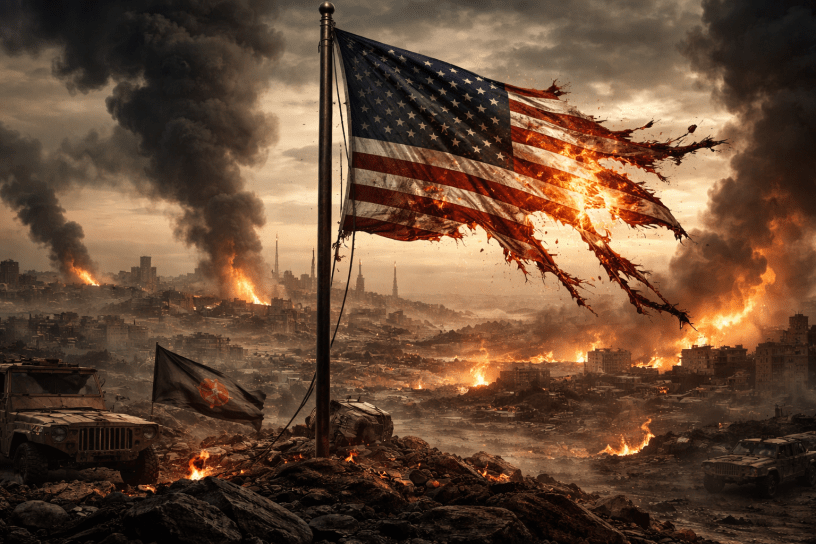
There is a point in every failed American war when the vocabulary begins to change.
Victory becomes progress. Progress becomes leverage. Leverage becomes creating conditions. Creating conditions becomes bringing the enemy back to the negotiating table. And eventually, after enough aircraft carriers have been shuffled around, enough missiles fired, enough billions vaporized and enough politicians have appeared on television insisting that everything is going exactly according to plan, the original plan mysteriously disappears altogether.
We have reached that point with Iran.
So perhaps it is time to say the thing Washington will spend the next several years inventing new phrases to avoid saying:
We lost.
Not militarily, in the narrow sense. The United States military can destroy more Iranian buildings in an afternoon than Iran could destroy American ones in a decade. American and Israeli forces inflicted devastating damage on Iran’s armed forces, missile infrastructure and leadership. Iran’s old supreme leader is dead. Large portions of its military apparatus have been bombed into expensive gravel.
That is all true.
It is also increasingly irrelevant.
Wars are not demolition contests. They are fought to accomplish political objectives. And nearly six months after the United States and Israel launched the war on February 28, Iran’s government is still there, its nuclear future remains unresolved, its regional influence has not disappeared, the Strait of Hormuz remains the central point of global economic blackmail, and Washington is once again reaching for sanctions because the bombs didn’t produce the surrender we were promised.
If this is victory, one wonders what losing would have looked like.
Remember What We Were Supposed to Win
One of the conveniences of constantly changing the objectives of a war is that nobody can ever quite prove you failed to achieve them.
At various points, the goals of the Iran campaign have included destroying Iran’s nuclear program, eliminating its missile capability, crushing its proxy network, protecting American allies, reopening international shipping, forcing Tehran into a comprehensive agreement and — during the more exuberant moments — encouraging regime change.
A remarkably ambitious shopping list.
Back in April, analysts were already noting that the administration had articulated several different definitions of victory, ranging from ending the nuclear program to degrading missiles and proxies all the way up to changing the government in Tehran.
Well, let’s check the scoreboard.
Regime change?
Ali Khamenei was killed. Iran replaced him with another hard-line supreme leader. The Islamic Republic did not collapse. There were no jubilant crowds tearing down the regime while Toby Keith played mysteriously from loudspeakers across Tehran. The system absorbed the blow, reorganized and kept fighting.
The nuclear threat?
Still negotiating about it.
The missiles?
Iran was badly damaged, but apparently nobody informed the Iranians that their missile program had been permanently eliminated. Tehran has continued rebuilding missile and drone capabilities, while American officials have found themselves worrying about something much more awkward: our own ammunition supply. Reuters reported this month that the United States has burned through much of its stockpile of some long-range precision weapons during the five-month campaign, creating concerns about readiness for another major conflict.
The proxies?
Still there.
Regional stability?
Please.
And then there is the Strait of Hormuz, which might be the most humiliating item on the entire ledger.
The United States entered this war as the world’s dominant military superpower. Iran entered it as a battered regional power with an economy under sanctions. Yet by August, Tehran was still using the world’s most important oil artery as leverage, insisting on its authority over the strait while Washington desperately tried to get commercial traffic moving normally again. Iran is now discussing its own arrangement with Oman for reopening the waterway.
This is not what unconditional surrender looks like.
We Won Every Battle Except the One That Mattered
Americans have an understandable tendency to confuse military superiority with strategic success.
We have extraordinarily good bombers. Therefore, whatever the bombers are doing must constitute winning.
This is roughly like congratulating yourself for owning the world’s finest hammer after spending six months trying unsuccessfully to repair a dishwasher with it.
Iran has been hurt enormously. Thousands of people across the region have been killed and tens of thousands injured during the wider conflict. Iran’s military and economy have suffered terribly. None of this should be minimized.
But suffering is not surrender.
The Vietnamese suffered more than the Americans in Vietnam. America still lost Vietnam. The Taliban suffered casualties on a scale vastly beyond the United States in Afghanistan. Twenty years later, they were sitting in Kabul while we were evacuating the embassy.
The question is never simply who absorbed more punishment?
The question is: Who accomplished what they were trying to accomplish?
Iran’s most basic objective was survival.
It survived.
Its government survived. Its security apparatus survived. Its ability to impose costs on the United States and its allies survived. Its nuclear program remains a subject for negotiation rather than a closed historical chapter. And despite being pounded by the most technologically sophisticated military coalition on Earth, Tehran has managed to drag the United States into the one kind of war America repeatedly proves terrible at finishing: the open-ended kind.
Meanwhile, the United States has spent tens of billions of dollars. Defense Secretary Pete Hegseth put the direct cost at roughly $37.5 billion by late July. American service members have been killed and hundreds wounded. The Navy has had to rotate exhausted carrier forces through the region, with the USS Abraham Lincoln spending an extraordinary stretch in the combat zone before being relieved.
And what have we purchased?
Another negotiation.
That is the part that should drive Americans insane.
After all the explosions, assassinations, funerals, intercepted missiles, depleted magazines, disrupted oil markets and magnificent graphics on cable news showing arrows sweeping across maps of Iran, we have arrived at the diplomatic table discussing many of the same questions we supposedly went to war to settle.
Only now everyone has more dead relatives.
Victory Has Become “Maybe Sanctions Will Work”
The most revealing development may be the administration’s recent return to economic pressure.
After months of war, the White House is again emphasizing sanctions as a way to force Tehran into concessions.
Wonderful.
Apparently we have discovered sanctions.
Someone should check the basement at the State Department and see if they can also locate a fax machine and a copy of the 2015 nuclear agreement.
The absurdity is difficult to overstate. America withdrew from the previous nuclear agreement, spent years applying “maximum pressure,” eventually entered a shooting war, killed Iran’s supreme leader, bombed enormous portions of its military infrastructure, blockaded the country, and is now returning to economic coercion in hopes of forcing Iran into negotiations over its nuclear program.
We have taken the scenic route back to diplomacy.
Even the much-heralded June framework failed to settle the central disputes. The agreement created a 60-day period for negotiating a permanent settlement. That deadline has now arrived with the major questions still unresolved: Iran’s nuclear program, sanctions, the blockade and control of the Strait of Hormuz.
This was supposed to be the period when military victory was converted into political victory.
Instead, Iran wants sanctions relief, compensation, greater control over its regional security environment and recognition of its position in the Strait. Washington wants Iran denuclearized and Hormuz reopened.
In other words, both sides still want approximately what they wanted before everyone started shooting.
Trump has repeatedly threatened enormous new attacks, only to delay them while negotiations sputter forward. Earlier this month he described talks as Iran’s “last chance.” Then the massive strikes didn’t happen. Then negotiations remained uncertain.
The last chance has begun to resemble a Bed Bath & Beyond going-out-of-business sale: apparently there will be another final day tomorrow.
Losing Doesn’t Mean Iran Won
This is where the patriotic reflex usually kicks in.
So you’re cheering for Iran?
No.
Iran’s government is brutal. It sponsors armed groups throughout the region, represses its own population and has spent decades playing dangerous games with terrorism, missiles and nuclear technology. Nothing about acknowledging American strategic failure requires pretending Tehran is admirable.
Nor does it require pretending Iran emerged unscathed.
Iran has been battered.
But those facts do not transform an unsuccessful American war into a successful one.
You cannot define victory as “we hurt them more.”
The United States did not embark on a multibillion-dollar war merely to demonstrate that American explosives function as advertised. We already knew that.
We went to war because our leaders claimed military force would solve a set of problems.
Those problems are still here.
And perhaps the most dangerous thing America can do now is refuse to admit it.
Because that is how unsuccessful wars become endless wars.
The government cannot stop because stopping would mean acknowledging that the objectives were not achieved. So a new objective is announced. Another deadline appears. Another carrier deploys. Another round of sanctions arrives. Another “final warning” is issued. Another strike is conducted to “restore deterrence.” Each failure becomes justification for doing more of the thing that failed.
Vietnam had light at the end of the tunnel.
Afghanistan had corners we were constantly turning.
Iran has last chances.
The language changes.
The war remains.
There is still an opportunity to salvage something from this disaster. Negotiate the nuclear question. Restore international shipping. Exchange verifiable concessions. Reduce the American military commitment. Stop pretending that every compromise is Munich in 1938 and every adversary is Hitler with enrichment centrifuges.
But doing that requires abandoning the fantasy that somewhere, hidden beneath the rubble, there is a spectacular American victory waiting to be discovered.
There isn’t.
Iran didn’t defeat the United States military.
It did something much more important.
It endured it.
And after nearly six months, tens of billions of dollars, American deaths, thousands of regional casualties, staggering quantities of expended weaponry and endless declarations that victory was right around the corner, the United States still has not achieved the political settlement the war was supposed to deliver.
Call it a setback.
Call it an inconclusive outcome.
Call it strategic disappointment.
Call it Operation Extremely Complicated Fury if that helps.
But eventually grown countries have to use grown-up words.
We lost.

